

Headless Marketplaces
Headless Marketplaces
Startups like Instinct have reached sky-high valuations in no time, while major companies are racing to launch agents of their own. Personal AI assistants are going mainstream – and that could reshape the business models built around them. This article explores how the future of agentic commerce could look like.
Marketplaces are dead. Long live marketplaces.
Some argue that mainstream AI agents will kill marketplaces. The “marketplaces are dead” argument goes something like this: once AI agents can find suppliers, compare offers and buy on our behalf, there is little reason to visit a marketplace. The agent takes over the customer interface and connects directly with the supplier. Under this view, the platform where supply and demand used to meet becomes an unnecessary intermediary. The underlying debate has been developing for some time. In its October 2025 report on agentic commerce, McKinsey described a potential shift away from destinations such as Amazon and Expedia towards personal assistants, with implications for customer relationships and advertising revenues. Citrini Research and Alap Shah take this argument further in The 2028 Global Intelligence Crisis, a hypothetical scenario in which agents erode habitual customer loyalty and seek cheaper routes around intermediaries. That possibility also raises a question about who supplies and supports the transactions when customers stop starting at a marketplace’s storefront.
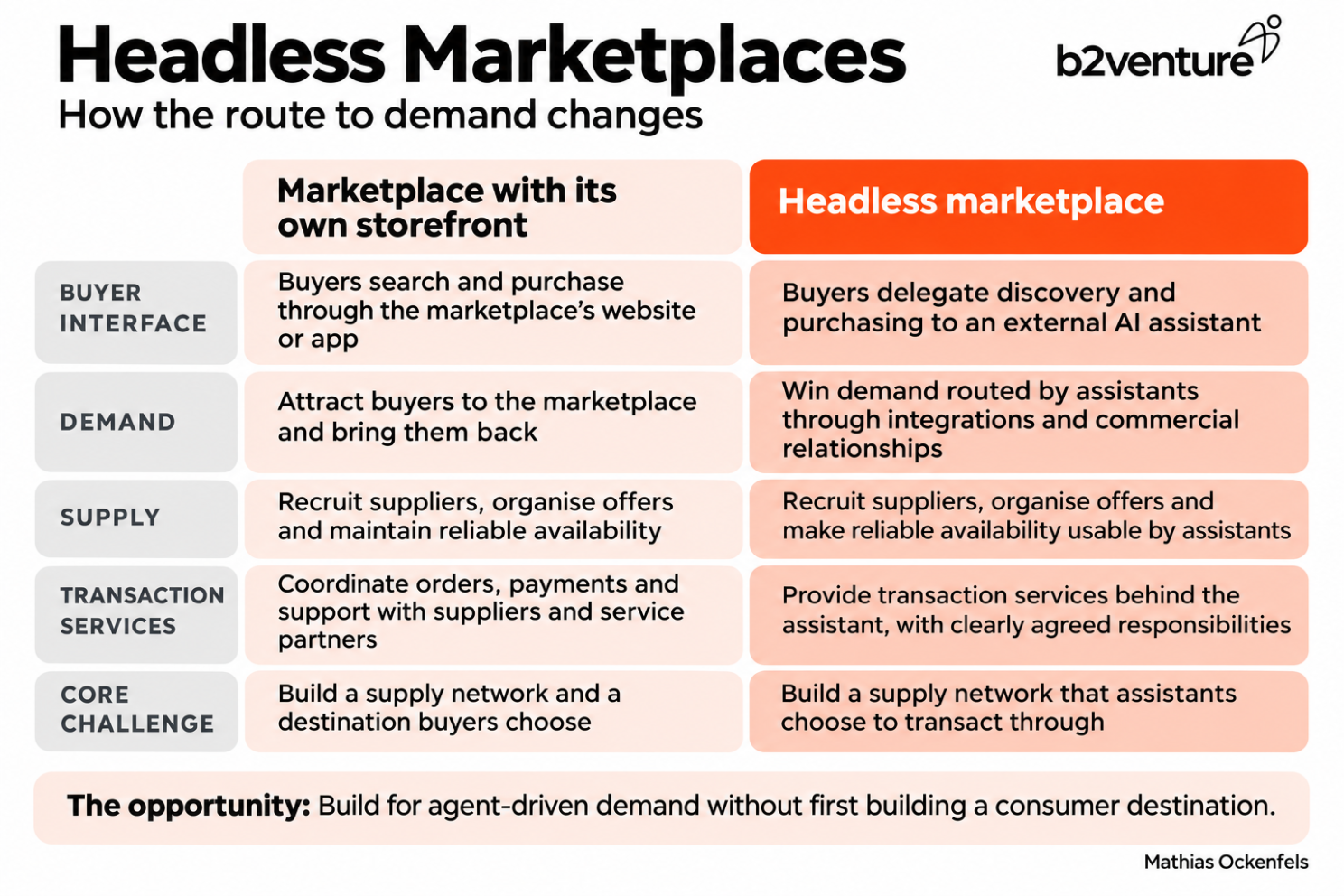
Where others see a threat to marketplaces, I see an opportunity. The same shift could create an opening for a new generation of marketplaces, which I think of as “headless marketplaces”: marketplaces whose primary route to the buyer runs through someone else’s interface. As people begin delegating purchases to personal AI assistants, founders may be able to reach customers through those assistants without first persuading them to adopt another marketplace. Those purchases still require reliable supply, usable commercial terms and someone who can make the transaction work. Founders could build businesses around assembling that supply and serving demand through assistants from the outset. The change that threatens an incumbent’s storefront could therefore make it easier for a new marketplace to get started.
Headless marketplaces would aggregate multiple suppliers, make their offers comparable and support transactions, while personal assistants handle much of the interaction with one or even multiple sides of the transaction. In this role, they would provide an infrastructure layer for agents, combining access to a supplier network with the commercial arrangements and operational services needed to complete purchases. They might still have websites, supplier dashboards and support teams. An established marketplace could develop into this role, or a founder could build for it from the outset. My interest is in where demand from AI assistants creates an opening for that second path.
Travel offers a useful precedent. Global distribution systems such as Amadeus connect travel suppliers with agencies and other sellers, while booking APIs such as Expedia’s Rapid API and Duffel let partners build travel experiences on top of aggregated inventory. One way to understand headless marketplaces is as an extension of that distribution logic to AI assistants, potentially across categories beyond travel. The opportunity is to build supply networks around this emerging source of demand, including in markets where aggregation has previously been difficult or uneconomic, e.g., as illustrated by our portfolio company Ambio, a B2B platform for recycled plastics. Existing distributors could serve that demand too, so a new entrant would still need an advantage in supply, service or economics.
I explored the foundations of this argument in my Marketplaces x AI series earlier this year. In The End of Marketplaces As We Know Them, I argued that agents could absorb parts of discovery without replacing the work of building supply networks and institutional trust. The Great Discontinuity examined the opening for new entrants, while The HAHO Framework focused on coordinating complex physical markets and becoming a dependable endpoint for agents. Much of that was still a thesis about how the market might develop. We can now examine actual assistant products, purchasing integrations and decisions by incumbents about which agents they will serve
The rise of personal AI assistants
I use personal AI assistants here to mean AI products that use a person’s context and preferences to carry out tasks across services. They can help with personal or work tasks; their capabilities and approval requirements vary. Agents is the broader term, which also includes specialised systems such as a company’s purchasing agent. Instinct, Muse and Town make different parts of this shift tangible. Instinct offers an assistant people can text or call to handle tasks such as ordering groceries or planning a getaway. Meta’s Muse brings an agent into channels including WhatsApp, with travel booking among its advertised capabilities. Town is more focused on work, connecting email, calendars and documents so an assistant can act with the user’s context. These products begin with a person and their tasks, potentially giving them a role in deciding which service gets used next.
The evidence is becoming more concrete than user growth alone. In his September interview on Invest Like the Best, Instinct founder Noah Shinn described roughly $1 billion in annualised transaction volume, with about half coming from travel. He said 40% of users share a personal credit card within three weeks. Reported retention was around 80% among users who had shared sensitive information, although the public summaries do not specify the retention period. These are founder-reported figures, but they suggest that some consumers are already willing to entrust assistants with purchases. As Olivia Moore noted in her October 5 review, Instinct had not yet begun collecting transaction fees. The spending is therefore an indication of demand, with monetisation still ahead. Headless marketplaces could help turn that demand into actual revenue for assistants such as Instinct by assembling supply, handling transactions and agreeing commercial terms that give assistants a share of the revenue from the purchases they facilitate.
Muse provides another sign that consumer interest is translating into use. On Meta’s October 21 earnings call, Mark Zuckerberg said more than 10 million people in the US and Canada had set up Muse, with around a quarter using it on any given day. He described shopping as its most common use case, with an average purchase size above $200. Taken together with Instinct’s reported transaction activity this makes the prospect of personal assistants becoming a meaningful demand channel much more tangible than it was when I wrote the earlier series.
Much of my earlier argument focused on B2B markets. The consumer adoption now emerging around personal assistants adds another route to that opportunity. An assistant handling a hotel booking, a grocery order or a home repair needs businesses behind it that can provide reliable inventory, usable terms and fulfilment. Founders can build B2B products for those assistants and their suppliers, ultimately enabling a B2C experience. Headless marketplaces could be one part of that B2B2C structure: assembling supply across providers and making it available to several assistants. Consumer adoption could give these businesses a new source of demand, allowing them to build the supply network without first building a consumer audience of their own.
Agentic commerce and the innovator’s dilemma
The case of Booking.com
I recently shared a chart from a16z’s Growth team showing changes in market capitalization since Muse’s launch. Using Capital IQ data as of September 27, it put Booking Holdings down 15%, alongside declines at several other consumer platforms. The chart cannot tell us how much of that repricing was caused by AI assistants. But one plausible reading is that investors are beginning to price in a risk to the economics of owning the customer relationship. If Muse or Instinct becomes the place where a traveller chooses and books, Booking may have to share more of the value of that booking with the assistant.
Booking.com could remain central to the transaction in that scenario. It already has agent initiatives, and its Demand API lets approved partners support booking and payment flows without sending customers to Booking’s website. Its inventory, supplier relationships and service capabilities could make it a valuable partner for external agents. The potential pressure is on how much Booking keeps: an assistant that controls demand could seek a distribution fee or a share of the commission, even while Booking continues to supply and service the reservation. How much it could extract would depend on the alternatives available to both sides.
Alex Immerman and Santiago Rodriguez explore this tension in Who Gets Paid When AI Does the Shopping?, which helped prompt my thinking about personal assistants and online travel agencies. Their distinction between additional demand and orders an incumbent would have won anyway is useful for assessing whether sharing the economics makes commercial sense.
A transaction that arrives through an agent can be attractive if it brings incremental demand or replaces an expensive acquisition channel. The same arrangement can be less attractive if it replaces a customer who would otherwise have booked directly, while transferring part of the economics and the relationship to the assistant. The outcome depends on which business is being added and which business is being displaced.
This is where a potential opening for a new entrant appears. An incumbent can be technically ready to serve agents while facing a difficult transition in its economics. If Booking shifted a previously direct reservation to an assistant and paid that assistant for the order, its contribution from the booking could fall unless savings or additional business offset the payment. An established company has to manage that effect on current earnings while investing in a new channel. A startup can price agent distribution into its business from the beginning, without cannibalising an existing direct channel. This echoes the incentive problem in Clayton Christensen’s The Innovator’s Dilemma: the same opportunity can look less attractive through an incumbent’s existing profit model than through a new entrant’s. That asymmetry could give a startup time to establish a supply network. An incumbent may nevertheless accept lower margins to avoid losing the transaction altogether, so the opening depends on how it responds.
The case of Shopify
Shopify makes the alternative approach concrete. Its agentic storefronts make merchants’ products available in external interfaces, and its Meta channel supports Shopify-powered checkout on Meta surfaces, including Muse where available. An eligible merchant can receive an order through that interface, see it in Shopify and remain responsible for fulfilment, returns and customer service. Shopify’s merchant services, including payments, remain relevant even when the customer never starts at the merchant’s storefront. As I argued in a recent post on Shopify and Booking, Shopify is interesting precisely because it has something to lose: assistants could make the storefronts it helps merchants build less important for discovery and purchase decisions. It can nevertheless support that shift because checkout, payments and other commerce infrastructure can continue to generate revenue behind the new interface. This illustrates how the location of monetisation in the stack affects the incentive to open up.
The case of Instacart
Instacart shows how an existing marketplace can participate too. Its ChatGPT app, launched in December 2025, lets a customer turn a meal-planning conversation into a cart, review it and pay within ChatGPT. Instacart’s network then supplies the groceries and fulfils the order. This is a working example of separating the customer’s starting point from the marketplace that executes the transaction. It also provides a useful counterweight to the startup thesis: external agents can route more demand into an established network.
Instacart illustrates why existing network effects may survive the loss of the interface. An agent may prefer an incumbent precisely because it already has the broadest relevant supply, dependable fulfilment and a familiar process for resolving problems. Suppliers may continue to value that demand even if they no longer know which interface initiated it. A booking routed through an assistant can still strengthen the same underlying marketplace. Losing the starting point of the customer journey does not automatically mean losing the network. That strength makes an incumbent a potential partner for agents. As the economics discussed above suggest, whether it will offer access on terms those agents find attractive remains a separate question.
The case of Amazon
Amazon illustrates why restricting access can be a negotiating strategy. In How scared should Amazon be of agents?, Dan Hockenmaier argues that Amazon has little reason to accommodate agents while they bring limited demand, but may negotiate once that demand becomes commercially significant. His argument also challenges the case for a headless competitor: Amazon’s fulfilment and trust infrastructure would be difficult for a loosely assembled alternative to match. Losing the customer’s starting point would not necessarily remove its bargaining power.
For founders, my inference is that an incumbent’s reluctance can create a window without implying that it is incapable of adapting. The difficult timing question is whether assistants can bring enough demand to sustain a new supply network before the incumbent finds it worthwhile to agree terms with them. That window may be too short, or the incumbent’s remaining advantages too strong, for a new entrant to establish itself.
The blue ocean case
There is also an opportunity where no established marketplace has yet organised the relevant supply. Agent demand could make building that network worthwhile, although suppliers, brokers and software providers may already serve parts of the need. In either case, a new headless marketplace has to assemble supplier relationships and make transactions work. It can design that business for assistants from the outset, without first building a consumer destination.
This changes what the founding team has to build itself. Personal assistants cultivate the consumer relationship and bring purchasing intent; the headless marketplace concentrates on making supply available and dependable. In the fragmented markets I find most interesting, recruiting and coordinating suppliers can be the harder work and the more durable source of value. An assistant may make it easy to express a request, while finding someone who can fulfil it on reliable terms still requires relationships, local knowledge and operational work. If agents can supply enough demand, founders can focus their resources on that side of the market without simultaneously persuading consumers to adopt another destination.
Demand still has to be won through commercial relationships with assistants, and suppliers will need evidence that those relationships produce business. Within this broader architecture, my investment hypothesis concerns new supply networks built around agent demand from the outset. Their prospects depend on becoming useful enough that agents choose to transact through them, rather than through an incumbent or directly with suppliers.
For a founder, the practical question is where an agent’s existing supply options fall short, whether in access, commercial terms or reliable execution. In B2B procurement, a headless marketplace could integrate directly into suppliers’ ERP and order-management systems, drawing on current availability, customer-specific prices and lead times, then writing confirmed orders back into the supplier’s workflow. In travel, the equivalent might be a deep connection to a hotel’s property-management system. This develops the argument in my HAHO Framework: a marketplace can become more valuable by embedding itself in the operational workflows that make a transaction possible.
That integration could also create defensibility. A marketplace handling recurring orders, reconciling fulfilment updates and resolving exceptions becomes part of how a supplier operates. Replacing it may require migrating established processes and rebuilding confidence in their reliability, creating switching costs. Permissioned transaction data may also improve matching and execution. The value lies in the working relationships and processes built around the connection; a standard ERP connector alone is easy for competitors to offer too. The test is whether this depth delivers more dependable supply for agents and a service suppliers want to keep using.
For suppliers, the proposition would be access to agent-driven demand together with the services needed to fulfil it. A headless marketplace could coordinate orders, arrange payments and handle cancellations and customer support, earning a fee for that work. Suppliers would have a reason to participate if the combination brought additional profitable business or reduced the work involved in serving it.
Liability could be a further source of differentiation. In my HAHO Framework, I described a marketplace acting as a Liability Anchor: a counterparty that stands behind defined parts of a transaction. A headless marketplace could commit to arranging a replacement or funding a refund if a confirmed supplier fails to deliver, with clear terms about what it covers. Resolving a complaint is an operational service; accepting a contractual obligation to put things right adds a financial commitment. For an assistant, that could make the marketplace a more dependable partner than a collection of supplier connections.
A general-purpose assistant may prefer such a partner to building the sector expertise, claims operations and financial capacity required to underwrite transactions across every category it serves. This is a potential reason to buy infrastructure from a specialist even when the agent can technically reach suppliers itself. The marketplace would have to price and manage the risks it accepts, and the assistant would retain responsibility for its own commitments. My hypothesis is that combining useful supply with credible, clearly scoped guarantees could give a headless marketplace a stronger reason to exist and a service worth paying for.
New entrants would need to be precise about their own defensibility. Supply density means having enough relevant options in the right place and category to fulfil a request. Normalizing data makes those options easier to compare. Transaction histories may improve matching or fraud detection. Deep integrations can create switching costs, and a record of reliable service can build trust. These are different advantages. A cross-side network effect emerges when additional useful supply makes the marketplace more valuable to agents and their users, and the resulting demand makes participation more valuable to suppliers.
Potential risks and limitations of headless marketplaces
Open protocols could make parts of this opportunity disappear. Standards such as UCP and ACP are making commerce capabilities easier to expose across interfaces. MCP provides a way for agents to access tools and information, while AP2 addresses aspects of payment authorisation and evidence. If suppliers can connect through their existing software and assistants can discover and transact with them directly, another aggregation layer may be unnecessary. Better interoperability benefits existing platforms and individual merchants as well as startups.
That is a serious test of the thesis. A company whose main advantage is translating between two systems may find that advantage standardised away. A shared protocol, however, does not by itself recruit a missing supplier, secure a useful commercial agreement or ensure that availability reflects reality. The case for a new marketplace is strongest where those tasks remain difficult and valuable after connectivity becomes easier. Founders should assume that connecting systems will get cheaper and build around the work that still needs doing. For example, onboarding small independent hotels could still mean persuading owners to participate, agreeing which rooms and rates they will offer, and establishing how the property will honour a confirmed booking or handle an overbooking. A common protocol can simplify exchanging that information; building a dependable network of participating hotels still requires commercial and operational work.
Agents themselves could become competitors. If travel becomes a meaningful share of a personal assistant’s transactions, it may decide to build direct supplier relationships, buy an existing intermediary or assemble its own aggregation layer. A successful specialist could effectively teach its largest customer which market to enter. Serving several assistants would reduce dependence on any one of them, but it would not remove their incentive to negotiate harder or integrate vertically. The independent marketplace would need to keep offering better coverage, service or economics than each assistant could reasonably build for itself.
An agent channel could concentrate customer acquisition around a handful of assistants that decide where to send demand. Those assistants may charge distribution fees or change their commercial terms. Their bargaining power, however, comes with a constraint: users must trust them to choose well. An assistant that recommends a worse offer because the supplier pays more risks damaging the relationship on which its business depends. I would expect that constraint to be particularly strong when users pay for the assistant and expect it to act in their interests.
User trust may constrain paid preference, but it gives assistants a reason to scrutinise a headless marketplace’s fees as well. For a new marketplace, easier access to demand could therefore coexist with persistent pressure on margins. Its fee would need to be justified by better availability, execution or recourse than the assistant could obtain elsewhere. A cheaper direct connection may still be worse value if it produces more failed orders or leaves the buyer carrying more risk. The commercial test is whether the marketplace improves the overall outcome enough to justify its cost i.e. take rate.
Where to build?
Despite these objections, I see several areas worth exploring:
- Travel combines fragmented underlying supply with familiar transactions and an existing habit of distribution through intermediaries. There’s a lot of competition already, so a new entrant would need a specific advantage rather than another general hotel catalogue.
- Local services could offer opportunities where agents help convert enquiries into confirmed appointments, although local density, provider quality and exception handling will be demanding.
- B2B purchasing i.e.procurement is promising where finding qualified suppliers and agreeing workable terms still involves substantial manual and financial coordination. There, the first useful buyer may be a company’s purchasing agent rather than a consumer’s personal assistant.
The opportunity depends on the specific transaction, not just the category. A familiar hotel booking and a purchase requiring additional verification may support very different businesses. I’m developing a follow-up framework to assess where intermediation adds value, where a new entrant can win that role and what could make its position defensible. It examines transactions across B2B, B2C and C2C, both with and without an established marketplace. If you see examples where a headless approach could serve buyers and suppliers better, or where existing providers already do the job well, I’d welcome your perspective.
As an investor, I would look for an initial market where a team can make supply meaningfully more useful to agents and demonstrate that suppliers benefit from participating. The early evidence could be quite concrete: requests fulfilled that alternative sources could not handle, better net economics for suppliers, repeat transactions across more than one demand partner, and higher fill rate as the network develops. These would help distinguish a durable headless marketplace from a temporary distribution arrangement.
I remain optimistic about what this could mean for marketplace formation. Personal assistants may give founders a way to reach demand without acquiring consumers one by one. They still need rails on which to run: dependable supply and the operational, financial and contractual arrangements that turn a request into a completed transaction. Incumbents and assistants will build some of those rails themselves, and competing providers may make others increasingly interchangeable. My hypothesis is that independent headless marketplaces can earn a durable place where their supplier networks, operational and financial capabilities and commitments deliver outcomes that alternatives cannot easily match. Deep integrations and responsibility for transactions matter when they contribute to that advantage.
The markets I would watch most closely are those where assistants can bring demand to fragmented supply that no marketplace has yet organised effectively, and those where incumbents could serve that demand but find the transition economically difficult. In the latter, the window may be narrow or disappear as incumbents adapt. Where either opening exists, founders may have room to build the rails for a new marketplace. For me, that is a hypothesis worth pursuing.
If you are building a headless marketplace, or thinking about starting one, I’d love to hear from you. My inbox is open.
Startups like Instinct have reached sky-high valuations in no time, while major companies are racing to launch agents of their own. Personal AI assistants are going mainstream – and that could reshape the business models built around them. This article explores how the future of agentic commerce could look like.
Marketplaces are dead. Long live marketplaces.
Some argue that mainstream AI agents will kill marketplaces. The “marketplaces are dead” argument goes something like this: once AI agents can find suppliers, compare offers and buy on our behalf, there is little reason to visit a marketplace. The agent takes over the customer interface and connects directly with the supplier. Under this view, the platform where supply and demand used to meet becomes an unnecessary intermediary. The underlying debate has been developing for some time. In its October 2025 report on agentic commerce, McKinsey described a potential shift away from destinations such as Amazon and Expedia towards personal assistants, with implications for customer relationships and advertising revenues. Citrini Research and Alap Shah take this argument further in The 2028 Global Intelligence Crisis, a hypothetical scenario in which agents erode habitual customer loyalty and seek cheaper routes around intermediaries. That possibility also raises a question about who supplies and supports the transactions when customers stop starting at a marketplace’s storefront.
Where others see a threat to marketplaces, I see an opportunity. The same shift could create an opening for a new generation of marketplaces, which I think of as “headless marketplaces”: marketplaces whose primary route to the buyer runs through someone else’s interface. As people begin delegating purchases to personal AI assistants, founders may be able to reach customers through those assistants without first persuading them to adopt another marketplace. Those purchases still require reliable supply, usable commercial terms and someone who can make the transaction work. Founders could build businesses around assembling that supply and serving demand through assistants from the outset. The change that threatens an incumbent’s storefront could therefore make it easier for a new marketplace to get started.
Headless marketplaces would aggregate multiple suppliers, make their offers comparable and support transactions, while personal assistants handle much of the interaction with one or even multiple sides of the transaction. In this role, they would provide an infrastructure layer for agents, combining access to a supplier network with the commercial arrangements and operational services needed to complete purchases. They might still have websites, supplier dashboards and support teams. An established marketplace could develop into this role, or a founder could build for it from the outset. My interest is in where demand from AI assistants creates an opening for that second path.
Travel offers a useful precedent. Global distribution systems such as Amadeus connect travel suppliers with agencies and other sellers, while booking APIs such as Expedia’s Rapid API and Duffel let partners build travel experiences on top of aggregated inventory. One way to understand headless marketplaces is as an extension of that distribution logic to AI assistants, potentially across categories beyond travel. The opportunity is to build supply networks around this emerging source of demand, including in markets where aggregation has previously been difficult or uneconomic, e.g., as illustrated by our portfolio company Ambio, a B2B platform for recycled plastics. Existing distributors could serve that demand too, so a new entrant would still need an advantage in supply, service or economics.
I explored the foundations of this argument in my Marketplaces x AI series earlier this year. In The End of Marketplaces As We Know Them, I argued that agents could absorb parts of discovery without replacing the work of building supply networks and institutional trust. The Great Discontinuity examined the opening for new entrants, while The HAHO Framework focused on coordinating complex physical markets and becoming a dependable endpoint for agents. Much of that was still a thesis about how the market might develop. We can now examine actual assistant products, purchasing integrations and decisions by incumbents about which agents they will serve
The rise of personal AI assistants
I use personal AI assistants here to mean AI products that use a person’s context and preferences to carry out tasks across services. They can help with personal or work tasks; their capabilities and approval requirements vary. Agents is the broader term, which also includes specialised systems such as a company’s purchasing agent. Instinct, Muse and Town make different parts of this shift tangible. Instinct offers an assistant people can text or call to handle tasks such as ordering groceries or planning a getaway. Meta’s Muse brings an agent into channels including WhatsApp, with travel booking among its advertised capabilities. Town is more focused on work, connecting email, calendars and documents so an assistant can act with the user’s context. These products begin with a person and their tasks, potentially giving them a role in deciding which service gets used next.
The evidence is becoming more concrete than user growth alone. In his September interview on Invest Like the Best, Instinct founder Noah Shinn described roughly $1 billion in annualised transaction volume, with about half coming from travel. He said 40% of users share a personal credit card within three weeks. Reported retention was around 80% among users who had shared sensitive information, although the public summaries do not specify the retention period. These are founder-reported figures, but they suggest that some consumers are already willing to entrust assistants with purchases. As Olivia Moore noted in her October 5 review, Instinct had not yet begun collecting transaction fees. The spending is therefore an indication of demand, with monetisation still ahead. Headless marketplaces could help turn that demand into actual revenue for assistants such as Instinct by assembling supply, handling transactions and agreeing commercial terms that give assistants a share of the revenue from the purchases they facilitate.
Muse provides another sign that consumer interest is translating into use. On Meta’s October 21 earnings call, Mark Zuckerberg said more than 10 million people in the US and Canada had set up Muse, with around a quarter using it on any given day. He described shopping as its most common use case, with an average purchase size above $200. Taken together with Instinct’s reported transaction activity this makes the prospect of personal assistants becoming a meaningful demand channel much more tangible than it was when I wrote the earlier series.
Much of my earlier argument focused on B2B markets. The consumer adoption now emerging around personal assistants adds another route to that opportunity. An assistant handling a hotel booking, a grocery order or a home repair needs businesses behind it that can provide reliable inventory, usable terms and fulfilment. Founders can build B2B products for those assistants and their suppliers, ultimately enabling a B2C experience. Headless marketplaces could be one part of that B2B2C structure: assembling supply across providers and making it available to several assistants. Consumer adoption could give these businesses a new source of demand, allowing them to build the supply network without first building a consumer audience of their own.
Agentic commerce and the innovator’s dilemma
The case of Booking.com
I recently shared a chart from a16z’s Growth team showing changes in market capitalization since Muse’s launch. Using Capital IQ data as of September 27, it put Booking Holdings down 15%, alongside declines at several other consumer platforms. The chart cannot tell us how much of that repricing was caused by AI assistants. But one plausible reading is that investors are beginning to price in a risk to the economics of owning the customer relationship. If Muse or Instinct becomes the place where a traveller chooses and books, Booking may have to share more of the value of that booking with the assistant.
Booking.com could remain central to the transaction in that scenario. It already has agent initiatives, and its Demand API lets approved partners support booking and payment flows without sending customers to Booking’s website. Its inventory, supplier relationships and service capabilities could make it a valuable partner for external agents. The potential pressure is on how much Booking keeps: an assistant that controls demand could seek a distribution fee or a share of the commission, even while Booking continues to supply and service the reservation. How much it could extract would depend on the alternatives available to both sides.
Alex Immerman and Santiago Rodriguez explore this tension in Who Gets Paid When AI Does the Shopping?, which helped prompt my thinking about personal assistants and online travel agencies. Their distinction between additional demand and orders an incumbent would have won anyway is useful for assessing whether sharing the economics makes commercial sense.
A transaction that arrives through an agent can be attractive if it brings incremental demand or replaces an expensive acquisition channel. The same arrangement can be less attractive if it replaces a customer who would otherwise have booked directly, while transferring part of the economics and the relationship to the assistant. The outcome depends on which business is being added and which business is being displaced.
This is where a potential opening for a new entrant appears. An incumbent can be technically ready to serve agents while facing a difficult transition in its economics. If Booking shifted a previously direct reservation to an assistant and paid that assistant for the order, its contribution from the booking could fall unless savings or additional business offset the payment. An established company has to manage that effect on current earnings while investing in a new channel. A startup can price agent distribution into its business from the beginning, without cannibalising an existing direct channel. This echoes the incentive problem in Clayton Christensen’s The Innovator’s Dilemma: the same opportunity can look less attractive through an incumbent’s existing profit model than through a new entrant’s. That asymmetry could give a startup time to establish a supply network. An incumbent may nevertheless accept lower margins to avoid losing the transaction altogether, so the opening depends on how it responds.
The case of Shopify
Shopify makes the alternative approach concrete. Its agentic storefronts make merchants’ products available in external interfaces, and its Meta channel supports Shopify-powered checkout on Meta surfaces, including Muse where available. An eligible merchant can receive an order through that interface, see it in Shopify and remain responsible for fulfilment, returns and customer service. Shopify’s merchant services, including payments, remain relevant even when the customer never starts at the merchant’s storefront. As I argued in a recent post on Shopify and Booking, Shopify is interesting precisely because it has something to lose: assistants could make the storefronts it helps merchants build less important for discovery and purchase decisions. It can nevertheless support that shift because checkout, payments and other commerce infrastructure can continue to generate revenue behind the new interface. This illustrates how the location of monetisation in the stack affects the incentive to open up.
The case of Instacart
Instacart shows how an existing marketplace can participate too. Its ChatGPT app, launched in December 2025, lets a customer turn a meal-planning conversation into a cart, review it and pay within ChatGPT. Instacart’s network then supplies the groceries and fulfils the order. This is a working example of separating the customer’s starting point from the marketplace that executes the transaction. It also provides a useful counterweight to the startup thesis: external agents can route more demand into an established network.
Instacart illustrates why existing network effects may survive the loss of the interface. An agent may prefer an incumbent precisely because it already has the broadest relevant supply, dependable fulfilment and a familiar process for resolving problems. Suppliers may continue to value that demand even if they no longer know which interface initiated it. A booking routed through an assistant can still strengthen the same underlying marketplace. Losing the starting point of the customer journey does not automatically mean losing the network. That strength makes an incumbent a potential partner for agents. As the economics discussed above suggest, whether it will offer access on terms those agents find attractive remains a separate question.
The case of Amazon
Amazon illustrates why restricting access can be a negotiating strategy. In How scared should Amazon be of agents?, Dan Hockenmaier argues that Amazon has little reason to accommodate agents while they bring limited demand, but may negotiate once that demand becomes commercially significant. His argument also challenges the case for a headless competitor: Amazon’s fulfilment and trust infrastructure would be difficult for a loosely assembled alternative to match. Losing the customer’s starting point would not necessarily remove its bargaining power.
For founders, my inference is that an incumbent’s reluctance can create a window without implying that it is incapable of adapting. The difficult timing question is whether assistants can bring enough demand to sustain a new supply network before the incumbent finds it worthwhile to agree terms with them. That window may be too short, or the incumbent’s remaining advantages too strong, for a new entrant to establish itself.
The blue ocean case
There is also an opportunity where no established marketplace has yet organised the relevant supply. Agent demand could make building that network worthwhile, although suppliers, brokers and software providers may already serve parts of the need. In either case, a new headless marketplace has to assemble supplier relationships and make transactions work. It can design that business for assistants from the outset, without first building a consumer destination.
This changes what the founding team has to build itself. Personal assistants cultivate the consumer relationship and bring purchasing intent; the headless marketplace concentrates on making supply available and dependable. In the fragmented markets I find most interesting, recruiting and coordinating suppliers can be the harder work and the more durable source of value. An assistant may make it easy to express a request, while finding someone who can fulfil it on reliable terms still requires relationships, local knowledge and operational work. If agents can supply enough demand, founders can focus their resources on that side of the market without simultaneously persuading consumers to adopt another destination.
Demand still has to be won through commercial relationships with assistants, and suppliers will need evidence that those relationships produce business. Within this broader architecture, my investment hypothesis concerns new supply networks built around agent demand from the outset. Their prospects depend on becoming useful enough that agents choose to transact through them, rather than through an incumbent or directly with suppliers.
For a founder, the practical question is where an agent’s existing supply options fall short, whether in access, commercial terms or reliable execution. In B2B procurement, a headless marketplace could integrate directly into suppliers’ ERP and order-management systems, drawing on current availability, customer-specific prices and lead times, then writing confirmed orders back into the supplier’s workflow. In travel, the equivalent might be a deep connection to a hotel’s property-management system. This develops the argument in my HAHO Framework: a marketplace can become more valuable by embedding itself in the operational workflows that make a transaction possible.
That integration could also create defensibility. A marketplace handling recurring orders, reconciling fulfilment updates and resolving exceptions becomes part of how a supplier operates. Replacing it may require migrating established processes and rebuilding confidence in their reliability, creating switching costs. Permissioned transaction data may also improve matching and execution. The value lies in the working relationships and processes built around the connection; a standard ERP connector alone is easy for competitors to offer too. The test is whether this depth delivers more dependable supply for agents and a service suppliers want to keep using.
For suppliers, the proposition would be access to agent-driven demand together with the services needed to fulfil it. A headless marketplace could coordinate orders, arrange payments and handle cancellations and customer support, earning a fee for that work. Suppliers would have a reason to participate if the combination brought additional profitable business or reduced the work involved in serving it.
Liability could be a further source of differentiation. In my HAHO Framework, I described a marketplace acting as a Liability Anchor: a counterparty that stands behind defined parts of a transaction. A headless marketplace could commit to arranging a replacement or funding a refund if a confirmed supplier fails to deliver, with clear terms about what it covers. Resolving a complaint is an operational service; accepting a contractual obligation to put things right adds a financial commitment. For an assistant, that could make the marketplace a more dependable partner than a collection of supplier connections.
A general-purpose assistant may prefer such a partner to building the sector expertise, claims operations and financial capacity required to underwrite transactions across every category it serves. This is a potential reason to buy infrastructure from a specialist even when the agent can technically reach suppliers itself. The marketplace would have to price and manage the risks it accepts, and the assistant would retain responsibility for its own commitments. My hypothesis is that combining useful supply with credible, clearly scoped guarantees could give a headless marketplace a stronger reason to exist and a service worth paying for.
New entrants would need to be precise about their own defensibility. Supply density means having enough relevant options in the right place and category to fulfil a request. Normalizing data makes those options easier to compare. Transaction histories may improve matching or fraud detection. Deep integrations can create switching costs, and a record of reliable service can build trust. These are different advantages. A cross-side network effect emerges when additional useful supply makes the marketplace more valuable to agents and their users, and the resulting demand makes participation more valuable to suppliers.
Potential risks and limitations of headless marketplaces
Open protocols could make parts of this opportunity disappear. Standards such as UCP and ACP are making commerce capabilities easier to expose across interfaces. MCP provides a way for agents to access tools and information, while AP2 addresses aspects of payment authorisation and evidence. If suppliers can connect through their existing software and assistants can discover and transact with them directly, another aggregation layer may be unnecessary. Better interoperability benefits existing platforms and individual merchants as well as startups.
That is a serious test of the thesis. A company whose main advantage is translating between two systems may find that advantage standardised away. A shared protocol, however, does not by itself recruit a missing supplier, secure a useful commercial agreement or ensure that availability reflects reality. The case for a new marketplace is strongest where those tasks remain difficult and valuable after connectivity becomes easier. Founders should assume that connecting systems will get cheaper and build around the work that still needs doing. For example, onboarding small independent hotels could still mean persuading owners to participate, agreeing which rooms and rates they will offer, and establishing how the property will honour a confirmed booking or handle an overbooking. A common protocol can simplify exchanging that information; building a dependable network of participating hotels still requires commercial and operational work.
Agents themselves could become competitors. If travel becomes a meaningful share of a personal assistant’s transactions, it may decide to build direct supplier relationships, buy an existing intermediary or assemble its own aggregation layer. A successful specialist could effectively teach its largest customer which market to enter. Serving several assistants would reduce dependence on any one of them, but it would not remove their incentive to negotiate harder or integrate vertically. The independent marketplace would need to keep offering better coverage, service or economics than each assistant could reasonably build for itself.
An agent channel could concentrate customer acquisition around a handful of assistants that decide where to send demand. Those assistants may charge distribution fees or change their commercial terms. Their bargaining power, however, comes with a constraint: users must trust them to choose well. An assistant that recommends a worse offer because the supplier pays more risks damaging the relationship on which its business depends. I would expect that constraint to be particularly strong when users pay for the assistant and expect it to act in their interests.
User trust may constrain paid preference, but it gives assistants a reason to scrutinise a headless marketplace’s fees as well. For a new marketplace, easier access to demand could therefore coexist with persistent pressure on margins. Its fee would need to be justified by better availability, execution or recourse than the assistant could obtain elsewhere. A cheaper direct connection may still be worse value if it produces more failed orders or leaves the buyer carrying more risk. The commercial test is whether the marketplace improves the overall outcome enough to justify its cost i.e. take rate.
Where to build?
Despite these objections, I see several areas worth exploring:
- Travel combines fragmented underlying supply with familiar transactions and an existing habit of distribution through intermediaries. There’s a lot of competition already, so a new entrant would need a specific advantage rather than another general hotel catalogue.
- Local services could offer opportunities where agents help convert enquiries into confirmed appointments, although local density, provider quality and exception handling will be demanding.
- B2B purchasing i.e.procurement is promising where finding qualified suppliers and agreeing workable terms still involves substantial manual and financial coordination. There, the first useful buyer may be a company’s purchasing agent rather than a consumer’s personal assistant.
The opportunity depends on the specific transaction, not just the category. A familiar hotel booking and a purchase requiring additional verification may support very different businesses. I’m developing a follow-up framework to assess where intermediation adds value, where a new entrant can win that role and what could make its position defensible. It examines transactions across B2B, B2C and C2C, both with and without an established marketplace. If you see examples where a headless approach could serve buyers and suppliers better, or where existing providers already do the job well, I’d welcome your perspective.
As an investor, I would look for an initial market where a team can make supply meaningfully more useful to agents and demonstrate that suppliers benefit from participating. The early evidence could be quite concrete: requests fulfilled that alternative sources could not handle, better net economics for suppliers, repeat transactions across more than one demand partner, and higher fill rate as the network develops. These would help distinguish a durable headless marketplace from a temporary distribution arrangement.
I remain optimistic about what this could mean for marketplace formation. Personal assistants may give founders a way to reach demand without acquiring consumers one by one. They still need rails on which to run: dependable supply and the operational, financial and contractual arrangements that turn a request into a completed transaction. Incumbents and assistants will build some of those rails themselves, and competing providers may make others increasingly interchangeable. My hypothesis is that independent headless marketplaces can earn a durable place where their supplier networks, operational and financial capabilities and commitments deliver outcomes that alternatives cannot easily match. Deep integrations and responsibility for transactions matter when they contribute to that advantage.
The markets I would watch most closely are those where assistants can bring demand to fragmented supply that no marketplace has yet organised effectively, and those where incumbents could serve that demand but find the transition economically difficult. In the latter, the window may be narrow or disappear as incumbents adapt. Where either opening exists, founders may have room to build the rails for a new marketplace. For me, that is a hypothesis worth pursuing.
If you are building a headless marketplace, or thinking about starting one, I’d love to hear from you. My inbox is open.

The Author